
Based on the picking method, warehouse racking can be divided into two types: manual picking racking and mechanical picking racking. Manual picking racking refers to the most common shelf racking, while mechanical picking involves storing goods on pallets first, then using forklifts to store and retrieve them by the pallet load. Therefore, mechanical picking racking can be collectively referred to as pallet racking. Now, let’s provide a precise definition for pallet racking.
I. What is Pallet Racking?
Pallet racking is a storage system specifically designed for storing goods on pallets. It is typically composed of upright frames, beams, and sometimes decking or wire mesh. It is the most common and widely used type of warehouse racking, often referred to as beam racking or heavy-duty racking.
The basic working principle is simple: pallets loaded with goods are placed on two parallel beams. Each pallet position corresponds to two beams, allowing goods to be stored in multiple levels. This straightforward and efficient design makes it suitable for most warehouse storage needs.
II. Types of Pallet Racking
1. Selective Pallet Racking:
This is the most common and widely adopted pallet racking system. Structurally, it consists of beams and upright frames and can be combined with wire decking, dividers, back mesh, or drum supports depending on the type of goods being stored.
Advantages: high load capacity (usually over 500 kg per pallet), full selectivity, wide applicability, simple structure, easy assembly and disassembly, and relatively low cost.
Disadvantage: average space utilization.
2. Double-Deep Racking:
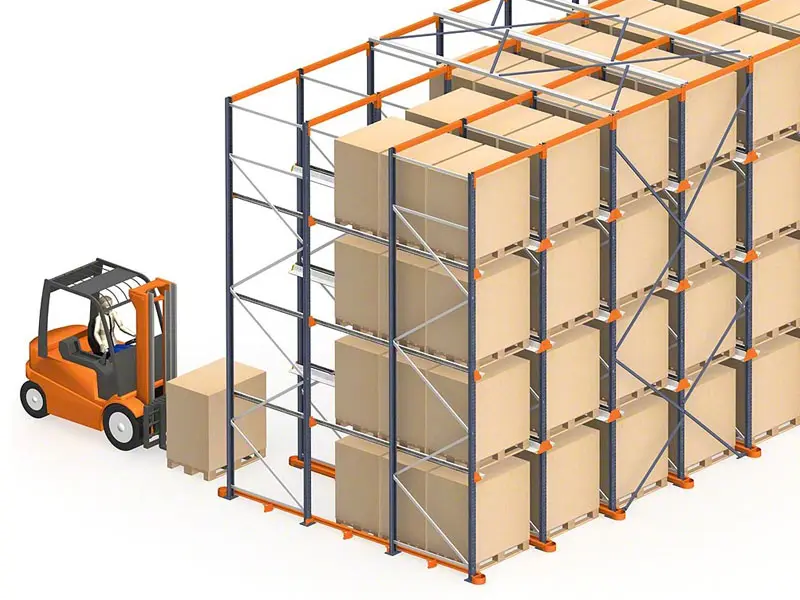
Also known as double-reach racking, this system has a similar structure to selective racking but stores pallets two deep. This design reduces the number of aisles required and increases storage density—allowing roughly twice the number of pallets per row compared to selective racking. Floor space utilization can reach up to 42%. However, stock selectivity is reduced to about 50%, and the system requires special double-reach forklifts. It is suitable for warehouses aiming to increase space efficiency while maintaining moderate selectivity.
3. Narrow-Aisle Racking:
As the name suggests, this system uses narrower forklift aisles—around 1.6 to 2 meters wide—to achieve higher storage density. Structurally, it’s similar to selective racking, but guide rails are installed on the floor for “man-up order pickers” or very narrow aisle (VNA) forklifts. The aisle width is only slightly wider than the pallet itself. This system keeps the benefit of 100% selectivity while improving space efficiency.
Disadvantages: higher equipment cost and greater skill requirements for forklift operators due to the narrow working space.
4. Drive-In Racking:
Drive-in racking eliminates the need for separate forklift aisles between rows. Forklifts drive directly into the racking structure to store or retrieve pallets. This setup can double the storage capacity compared with selective racking and is ideal for storing large quantities of uniform goods.
However, it has relatively weaker stability, so the depth is generally limited to around 7 pallets, and the height usually does not exceed 10 meters. To enhance stability, tie-backs and bracing are added to the structure.
5. Shuttle Racking:
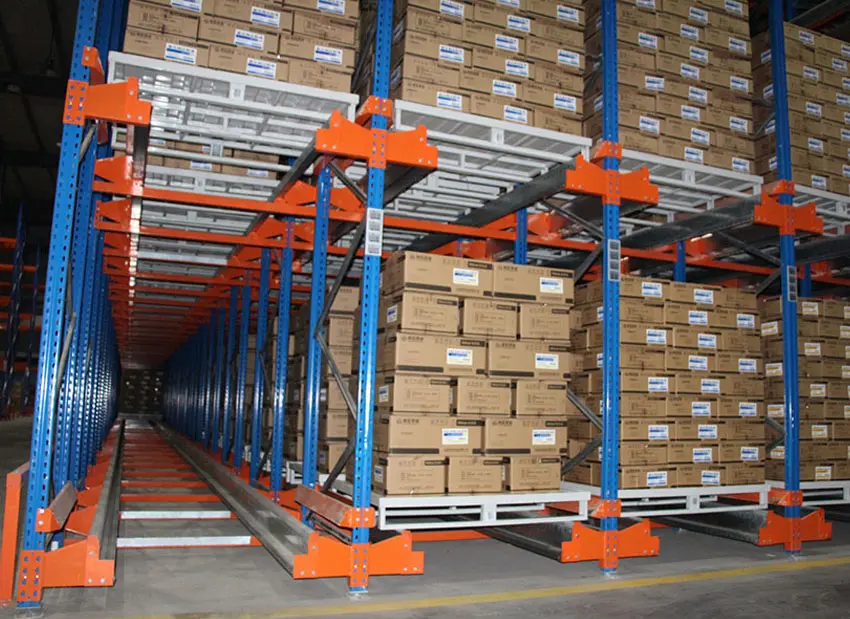
Shuttle racking is a type of high-density storage system. Like drive-in racking, it does not require dedicated forklift aisles within the rack. Instead, it uses battery-powered shuttle cars to move pallets automatically inside the lanes, achieving over 80% space utilization.
Compared to drive-in racking, its stability is much better. Since forklifts no longer enter the racking lanes, the risk of collision is reduced, improving both safety and operational efficiency. Shuttle systems are particularly suitable for cold storage, warehouses with a small number of SKUs but large quantities, FIFO inventory management, and facilities seeking to increase capacity.
Advantages of Using a Pallet Racking System
Implementing a pallet racking system brings significant operational and economic benefits:
- Maximize Warehouse Space – Make full use of vertical space to store more goods.
- Improve Inventory Management – Organized storage simplifies tracking and picking.
- Enhance Safety – Strong steel structures ensure safe and reliable load bearing.
- Increase Efficiency – Faster loading and unloading improve workflow.
- Flexible and Scalable – Can be adjusted or expanded as business grows.
How to Choose the Right Racking System
When selecting a racking system, consider these factors:
- Warehouse Layout – Measure height, aisle width, and available floor area.
- Load Requirements – Match the rack’s strength with pallet weight.
- Inventory Turnover – Choose FIFO or LIFO depending on product flow.
- Forklift Type – Ensure compatibility between forklifts and racking structure.
- Budget and Future Expansion – Select a system that fits current needs but allows future scaling.
Safety Tips for Pallet Racking Systems
Warehouse safety is always the top priority. Follow these essential practices:
- Regularly inspect racks for damage or loose connections.
- Never exceed the load limit of any beam level.
- Use quality pallets and distribute loads evenly.
- Install safety guards and rack protection posts.
- Train staff on proper forklift operation and warehouse safety.
Proper maintenance ensures long-term stability and safe operation.
Conclusion
Pallet racking systems are the foundation of modern warehouse management. They help maximize space, improve efficiency, and enhance operational safety.
By understanding different racking types and choosing the most suitable system for your facility, you can greatly improve storage performance and reduce costs.
If you are searching for a reliable pallet racking solution, feel free to contact our team. We provide customized warehouse racking designs tailored to your specific storage needs.