
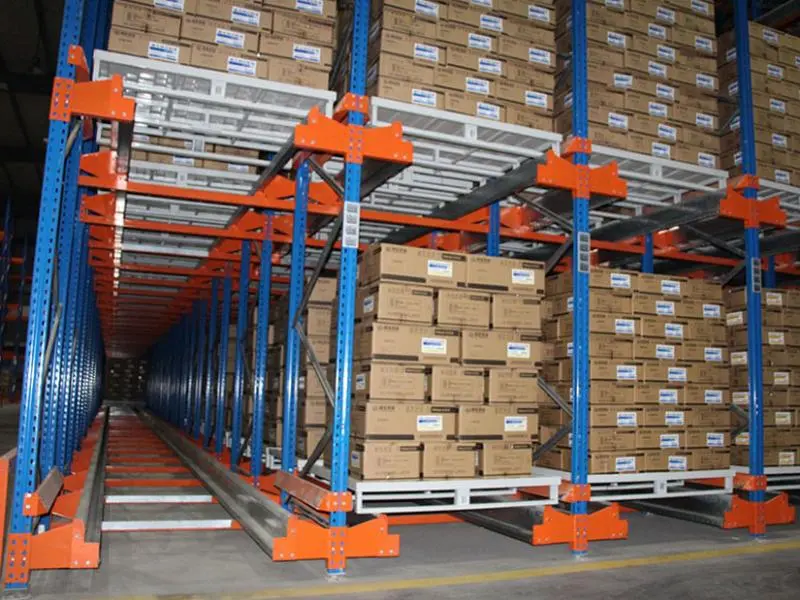
Product Introduction:
Shuttle racking is a high-density storage solution that combines the advantages of traditional drive-in racking with automated equipment. The system consists of the rack structure itself, remotely controlled shuttle cars, and forklifts working in coordination.
The core working principle is as follows: a forklift places a pallet-loaded goods onto a shuttle car at the entrance of a rack aisle. Upon receiving a wireless remote command, the shuttle car automatically travels along the rails within the aisle, stores or retrieves the goods, and positions them accurately, thereby achieving high-density compact storage. This system perfectly balances storage density, access efficiency, and operational costs, making it an ideal choice for modern logistics warehouses, as well as raw material and finished goods storage in manufacturing.
Features of Shuttle Racking:
• High-Density Storage, Significantly Improving Space Utilization
Goods are stored concentrically in multiple dense rack aisles, eliminating the need to reserve forklift lanes for each row. Warehouse space utilization can reach over 80%, nearly double that of traditional beam racking.
• Efficient Operation, Flexible Access
Shuttle cars can quickly and accurately move goods within the aisles. Forklifts only need to pick up and drop off goods at the aisle entrances, reducing their travel distance, turning, and lifting operations within the warehouse, significantly improving operational efficiency. Supports various operational modes such as First-In-First-Out (FIFO) or First-In-Last-Out (FILO), meeting different material management needs.
• Safe Operation, Reduces Goods Damage
The system operates stably, reducing the risks of collisions and damage to racks, goods, and personnel associated with forklifts entering narrow aisles.
• Reduces Operational Costs, Delivers Excellent Cost-Effectiveness
Due to reduced demands on forklift drivers and decreased forklift wear and energy consumption, long-term labor and equipment maintenance costs are effectively controlled.
• Good Stability, Strong Scalability
The system structure is robust with strong load-bearing capacity. Future capacity increases can be achieved by adding more shuttle cars or through modular system expansion, offering a high return on investment.
Product Specifications:
| Item | Specification |
|---|---|
| Load Capacity | 500–1,500 kg/pallet |
| Max Height | Up to 18 m |
| Pallet Size | 800–1,200 mm (W) × 900–1,600 mm (D) |
| Shuttle Speed | 1.0–1.2 m/s (loaded), 1.2–1.5 m/s (unloaded) |
| Battery | 24–48V lithium, 8–10 h |
| Control System | Wireless + WMS |
| Operating Temp. | -20°C to +40°C |
| Safety Features | Obstacle detection, emergency stop, overload protection |
Application Scenarios:
Shuttle racking systems are widely used in industries and scenarios requiring high-density storage and having high demands for goods management:
• Cold Chain Storage
Given the high operational costs of cold storage, the extremely high space utilization of shuttle racking significantly reduces unit storage costs. Furthermore, its characteristic of reducing forklift operation time helps maintain low temperatures inside the warehouse, resulting in notable energy savings.
• Food and Beverage Industry
Suitable for storing finished products and raw materials requiring batch management, perfectly achieving “First-In-First-Out” and ensuring product freshness.
• Manufacturing Industry
Used for storing large quantities of single-SKU raw materials (e.g., paper rolls, plastic pellets) or finished goods, providing stable, high-capacity buffer storage.
• Tobacco Industry
Meets the stringent requirements of the tobacco industry for high-density storage, precise batch management, and efficient logistics turnover.
• Third-Party Logistics and Distribution Centers
Helps logistics companies maximize the use of expensive warehouse space, cope with storage pressures from seasonal fluctuations, and enhance order processing capabilities.